English
This page explains how we teach writing at Park Street and how we support pupils to become confident, skilled and purposeful writers. Here, you will find information about our writing curriculum, our teaching approach and how writing progresses from Reception to Year 6.
Information about Reading and Phonics can be found here. Handwriting information is at the bottom of this page.
INTENT
At Park Street, our intent is to develop skilled, confident and motivated writers who can communicate effectively for a wide range of authentic purposes and audiences. Through HFL's ESSENTIAL WRITING curriculum, we ensure every child:
-
Builds deep knowledge of language, grammar, vocabulary and text structures.
-
Engages with high‑quality, diverse literature that inspires them to imitate, innovate and independently apply effective writing craft.
-
Understands the purpose of writing, whether to entertain, inform, persuade or discuss, and uses an appropriate repertoire of features for each.
-
Sees themselves as volitional writers, empowered to make authorial choices and motivated to write for real outcomes beyond the classroom.
-
Makes strong progress through a carefully sequenced and cumulative curriculum, with key skills revisited and deepened year-on-year.
Our overarching aim is for all children to become confident, fluent and purposeful writers who are well-prepared for the next stage of their education.
IMPLEMENTATION
We follow HFL's ESSENTIAL WRITING- an ambitious and progressive writing curriculum from Reception to Year 6, aligned closely with the National Curriculum and built around high‑quality literature. Each year group completes carefully structured units designed to build knowledge of grammar, composition and vocabulary in a logical, cumulative sequence.
Units are organised around four core writing purposes:
-
To entertain
-
To inform
-
To persuade
-
To discuss
Teachers use the ESSENTIAL WRITING materials to deliver a consistent, research‑informed approach to writing. This includes:
-
Using high‑quality model texts to highlight writing craft and explicitly teach genre features.
-
Building grammatical, compositional and transcriptional skills progressively within and across units.
-
Developing pupils’ discourse knowledge by analysing texts written for real audiences and purposes.
-
Drawing on strong subject knowledge and pedagogical guidance to scaffold learning and support adaptive teaching.
-
Ensuring writing outcomes are purposeful, with opportunities to publish, perform or share work to enhance authenticity and motivation.
-
Providing scaffolds and adaptive teaching strategies so pupils with SEND and other additional needs can access learning successfully.
-
Using long‑term overviews to ensure clear progression across year groups and cumulative development of writing skills.
-
Referring to model texts and exemplification to give clarity on age‑related expectations.
-
Embedding regular retrieval practice and revisiting of writing features to secure retention and continuous improvement.
Handwriting
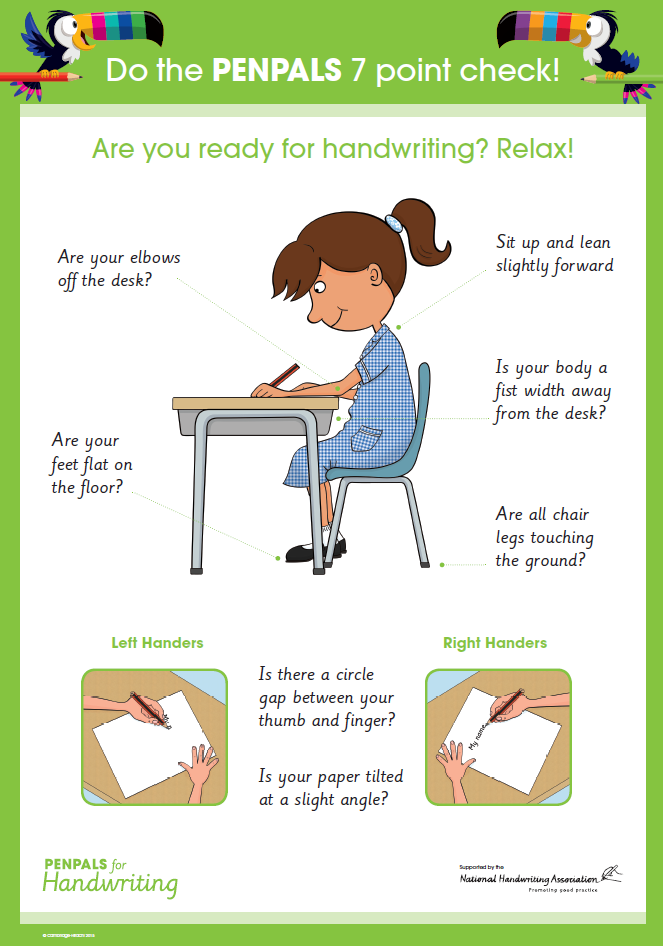
We are committed to developing pupils who take pride in their work and present their learning to a high standard. To support this, we use the Penpals handwriting scheme from Nursery through to Year 6. This provides a consistent, structured approach that builds strong foundations and ensures clear progression as children move through the school.
In the early years, handwriting is taught in line with the EYFS Framework and supported by Essential Letters and Sounds mnemonics to secure correct letter formation. From Year 1 onwards, Penpals offers frequent, discrete and direct teaching of handwriting, fully aligned with the expectations of the National Curriculum.
The scheme is organised into five developmental stages:
-
Physical preparation for handwriting
-
Securing correct letter formation
-
Beginning to join letters
-
Securing joins and developing fluency
-
Developing a confident personal style
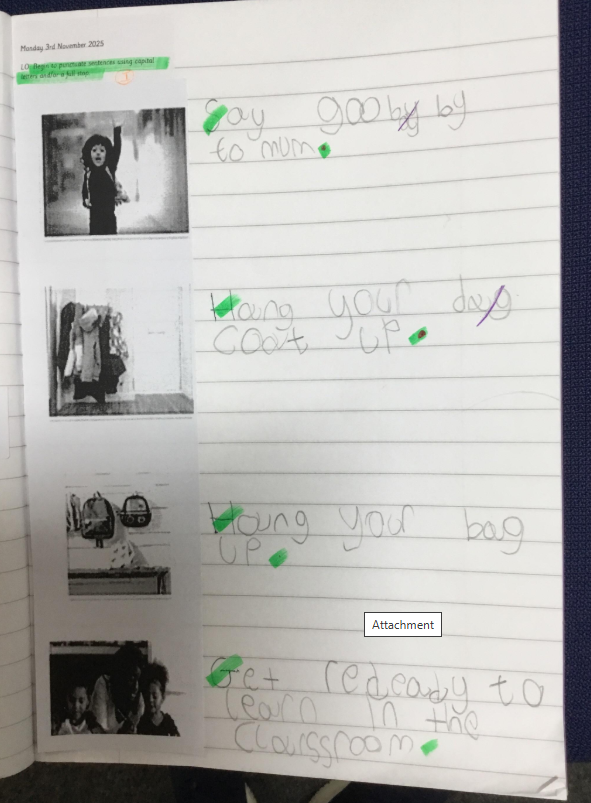
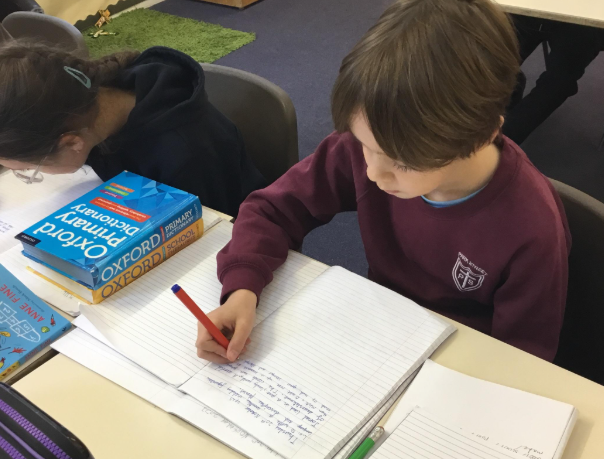
Children practise their handwriting in dedicated handwriting books, which provide the structure and support needed for developing clear, fluent and consistent letter formation. These books include handwriting lines that help pupils apply the correct size, spacing and joins, supporting high‑quality presentation across the curriculum.
Handwriting is also modelled and reinforced within phonics lessons, giving children regular opportunities to practise accurate letter formation in meaningful contexts.