
Mathematics
INTENT
At Park Street, our intent is to ensure all children become confident, fluent and resilient mathematicians with a deep and connected understanding of mathematical concepts. Using the White Rose Maths scheme from EYFS to Year 6, we aim to:
-
Develop strong mathematical fluency, enabling children to recall key number facts and use efficient methods with increasing confidence.
-
Ensure pupils can reason mathematically, using precise vocabulary to explain, justify and generalise their thinking.
-
Provide rich opportunities for problem-solving, helping children make connections, think logically and apply strategies flexibly.
-
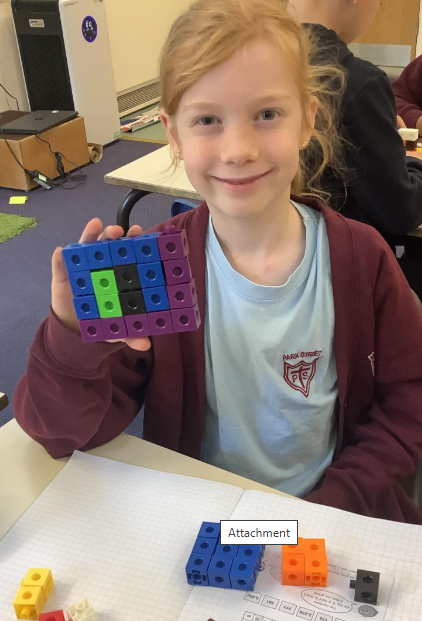
Build secure conceptual understanding through a mastery approach grounded in the Concrete–Pictorial–Abstract (CPA) model.
-
Foster curiosity and independence so pupils recognise mathematics as an essential life skill.
-
Ensure all learners, including disadvantaged pupils and those with SEND, can access and succeed within a well‑sequenced curriculum.
Our vision is for every pupil to experience confidence, enjoyment and success in mathematics, seeing themselves as capable mathematicians who can think deeply and solve problems independently.
IMPLEMENTATION
We teach mathematics through the White Rose Maths scheme from Reception to Year 6, providing a well‑sequenced and cumulative curriculum in which concepts are introduced in small steps and revisited regularly. Number is given strong emphasis as the foundation for later learning across geometry, measurement and statistics. Our mastery approach ensures that all pupils develop secure understanding and move through learning together at an appropriate pace.
Teaching is carefully structured so that pupils build deep and connected knowledge. Lessons follow a clear small‑step progression and make consistent use of the Concrete–Pictorial–Abstract (CPA) approach to secure conceptual understanding before pupils move to abstract methods. Daily teaching includes a balance of fluency, reasoning and problem‑solving, supported by high‑quality modelling and guided practice. To ensure consistency and high expectations, teachers adapt planning thoughtfully to meet pupils’ needs while maintaining fidelity to the White Rose progression.
Key features of our implementation include:
-
Small‑step progression that builds knowledge cumulatively
-
CPA approach used consistently to deepen conceptual understanding
-
Daily fluency, reasoning and problem‑solving embedded in every lesson
-
Clear modelling and structured independent tasks to support success
-
Adaptive teaching, including manipulatives, stem sentences and worked examples
-
Challenge for rapid graspers through deeper reasoning and application
-
Same‑day or next‑day intervention to prevent pupils falling behind
-
Regular retrieval practice, including Flashback 4, to strengthen long‑term retention
-
Explicit teaching of mathematical vocabulary to support precision and reasoning
Assessment is used effectively to inform teaching. Ongoing assessment for learning enables teachers to identify misconceptions and adjust instruction promptly, while termly assessments provide a broader picture of progress and inform future planning. This ensures pupils have sufficient time to secure key knowledge before moving on.
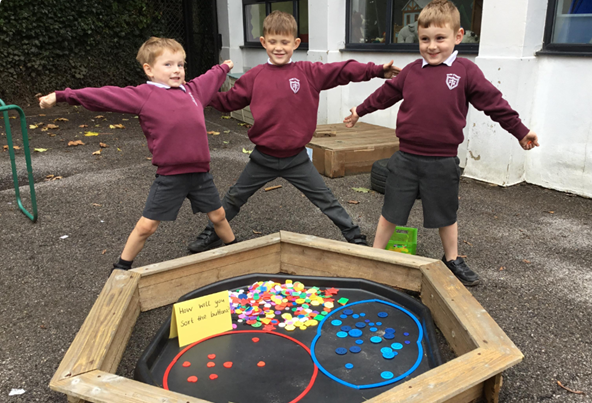
In the Early Years, children develop strong early number skills through play‑based and structured activities aligned with White Rose guidance. They use manipulatives to explore number, pattern and comparison in meaningful contexts, ensuring they are well-prepared for the transition into Key Stage 1 and for the mastery approach that follows.