RE
Discover how RE comes to life at Park Street – how we inspire curiosity, build confidence and create meaningful learning experiences that help children develop knowledge, understanding and respect for different beliefs and values so every child can flourish.
INTENT
At Park Street, we recognise Religious Education as a means for helping children to explore the spiritual dimensions of life and to lay the foundations for an understanding of Christianity and other world faiths. It is an integral part of school life and is central to the ethos of our school.
As stated in the Church of England Statement of Entitlement for Religious Education, our school aims for all pupils:
• To know about and understand Christianity as a diverse global living faith through the exploration of core beliefs using an approach that critically engages with biblical text.
• To gain knowledge and understanding of a range of religions and worldviews appreciating diversity, continuity and change within the religions and worldviews being studied.
• To engage with challenging questions of meaning and purpose raised by human existence and experience.
• To recognise the concept of religion and its continuing influence on Britain’s cultural heritage and in the lives of individuals and societies in different times, cultures and places.
• To explore their own religious, spiritual and philosophical ways of living, believing and thinking
IMPLEMENTATION
Religious Education (RE) at Park Street is planned and taught in line with the Hertfordshire Agreed Syllabus, supported by Understanding Christianity and Kapow units. Our curriculum is designed to be creative, knowledge-rich, and broad, ensuring pupils develop a deep understanding of religions and worldviews while building respect for diversity.
How we implement RE:
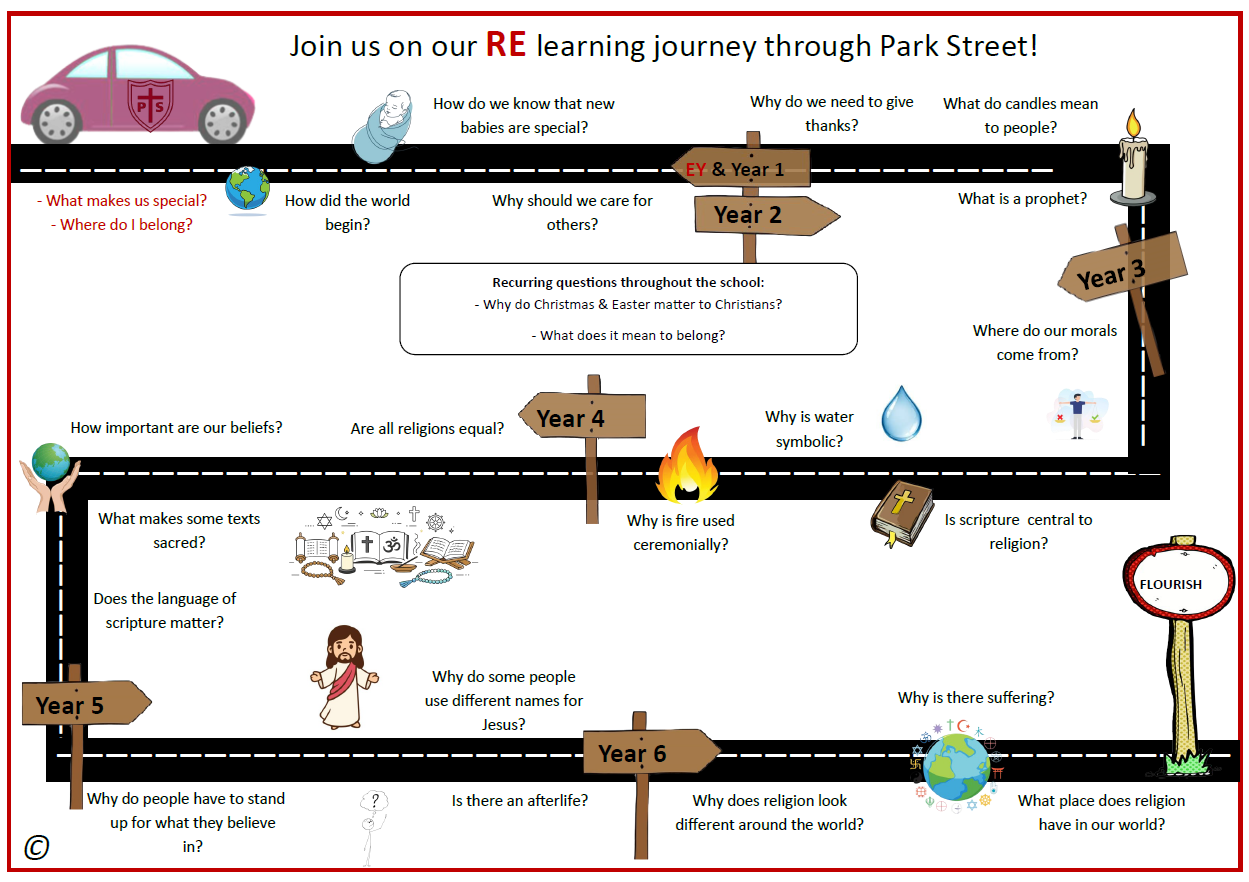
- Progressive and sequenced learning: Topics and themes build on prior knowledge through carefully planned progression in our long-term plan. Retrieval boxes are used to revisit and strengthen previous learning.
- Challenge and depth: As pupils move through the school, learning becomes increasingly challenging, encouraging higher-level thinking and reflection.
- Skills development: Lessons foster enquiry, analysis, interpretation, evaluation, and reflection, enabling pupils to engage thoughtfully with complex ideas.
- Dialogue and diversity: Pupils are given opportunities for meaningful and informed dialogue with those of different religions and worldviews, promoting respect and understanding.
- Safe and reflective spaces: RE lessons provide a safe environment for pupils to explore their own beliefs, values, and philosophical questions.
Curriculum content: The Hertfordshire Agreed Syllabus ensures coverage of eight key areas:
- Beliefs and practices
- Sources of wisdom
- Symbols and actions
- Prayer, worship and reflection
- Identity and belonging
- Ultimate questions
- Justice and fairness
- Human responsibility and values
Learning experiences include:
- Exploring and analysing key texts
- Pair and group discussions
- Using artefacts, images, music, and role-play
- Visits and visitors from local and wider communities
- Outdoor learning opportunities
- Time for personal reflection
Our RE curriculum presents religions and worldviews in all their richness and diversity, challenging stereotypes and misconceptions. Questions and opinions are treated with sensitivity and respect, encouraging pupils to develop positive attitudes towards diversity and inclusion.